Mazes & Minotaurs (Analog)(2015)
Analog Game Design • Systems Design • Level Layout • Team Project
Summary
Mazes & Minotaurs is an analog game designed in 2015 during my graduate studies, when I chose to retake Introduction to Game Design as part of my Master’s program. Returning to the course a second time gave me an opportunity to revisit foundational design principles with a more mature perspective, exploring systems, player psychology, and analog prototyping from a higher skill level.
Created collaboratively with two classmates, Mazes & Minotaurs challenged us to build a complete tabletop experience from scratch — including asymmetric roles, evolving spatial systems, player abilities, and dynamic win conditions. Although analog, this project played a pivotal role in shaping my early systems thinking and reinforced the value of iteration long before I began building digital games.
Project Overview
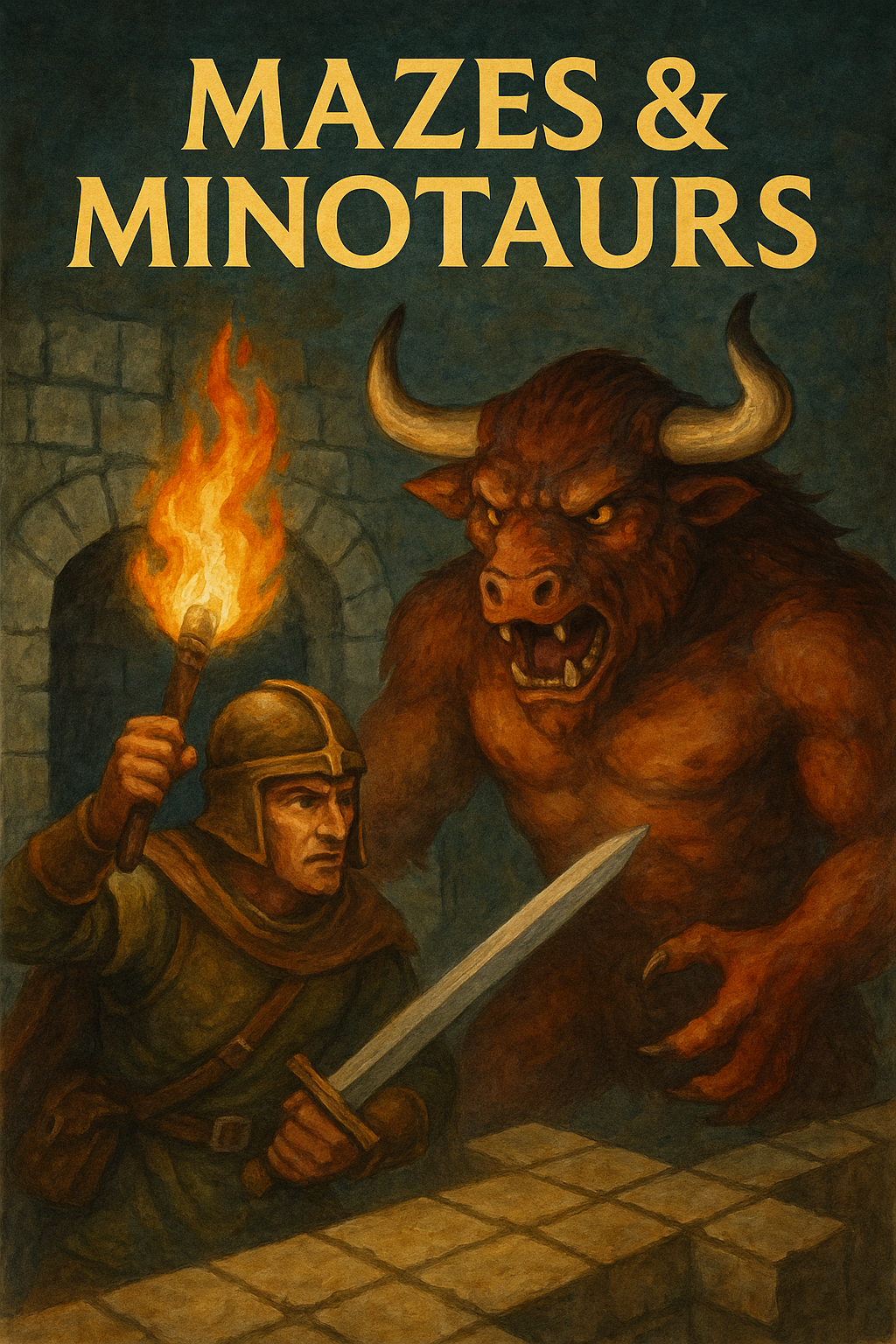
Mazes & Minotaurs is a hybrid dungeon-crawling, tile-placement, chase-and-escape board game where:
Four adventurers work together to escape a maze
A player-controlled Minotaur manipulates the labyrinth to trap them
The labyrinth itself is dynamic, constructed through modular tile placement
Each hero has unique stats, powers, and team utility
Victory can be group-based or individual, creating layered incentives
The game creates a tension-filled spatial puzzle where every turn reshapes the board — keeping players engaged, reactive, and strategic.
Tools Used
Paper prototypes and modular tiles
Tokens and dice
Early GDD drafting and PDF formatting tools
What I Worked On
Systems & Rules Design
Defined the turn structure, action economy, and stamina system
Designed asymmetric mechanics for both hero players and the Minotaur
Helped create key-based progression and treasure interactions
Wrote and refined major rule components, including movement, combat, and item use
Minotaur Mechanic Development
Assisted in creating the Minotaur’s teleportation, attack, and maze-manipulation systems
Helped tune difficulty by adjusting its mobility, interaction range, and recovery rules
Board & Layout Design
Contributed to rules governing tile placement, the core spatial mechanic
Helped develop movement constraints (wall-hugging, diagonals, door logic)
Iterated on balance for open areas vs. chokepoints in the modular maze design
Documentation & Clarity
Edited and formatted the full 6-page GDD
Created diagrams and clarified rules for player readability
Ensured consistency across treasure cards, door logic, and environmental behaviors
What I Learned
Analog Design Reveals Systemic Issues Immediately
Playtesters surfaced pacing problems faster than in digital prototypes.
Complexity Must Serve the Player, Not the Designer
Every rule needed a purpose — and clarity was more important than cleverness.
Asymmetrical Roles Require Guardrails
The Minotaur’s teleportation-after-attack mechanic became a critical balancing tool.
Team Collaboration Mirrors Real Studio Work
This was one of my earliest experiences splitting responsibilities across systems, layout, and documentation — a precursor to later industry teamwork.
Personal Reflection
Mazes & Minotaurs represents a meaningful moment in my growth as a designer. By revisiting an introductory course during my Master’s program, I was able to approach the fundamentals with new maturity — designing not just for novelty, but for usability, balance, and player engagement.
This project reaffirmed that great game design begins on paper. Before engines, before code, before tools — it’s about rules, incentives, clarity, and how players emotionally respond to the systems you create. Mazes & Minotaurs helped solidify those instincts and became a stepping stone toward the digital projects that followed.