Gobble Gobble (Analog)(2013)
Analog Board Game · First Game Design Document · Competitive Strategy · Dice & Resource Stealing
Summary
Gobble Gobble is the first board game I ever designed — and my first formal Game Design Document — created during my undergraduate Introduction to Game Design course in 2012–2013. It marked the beginning of my journey into game design, long before I made my first digital game.
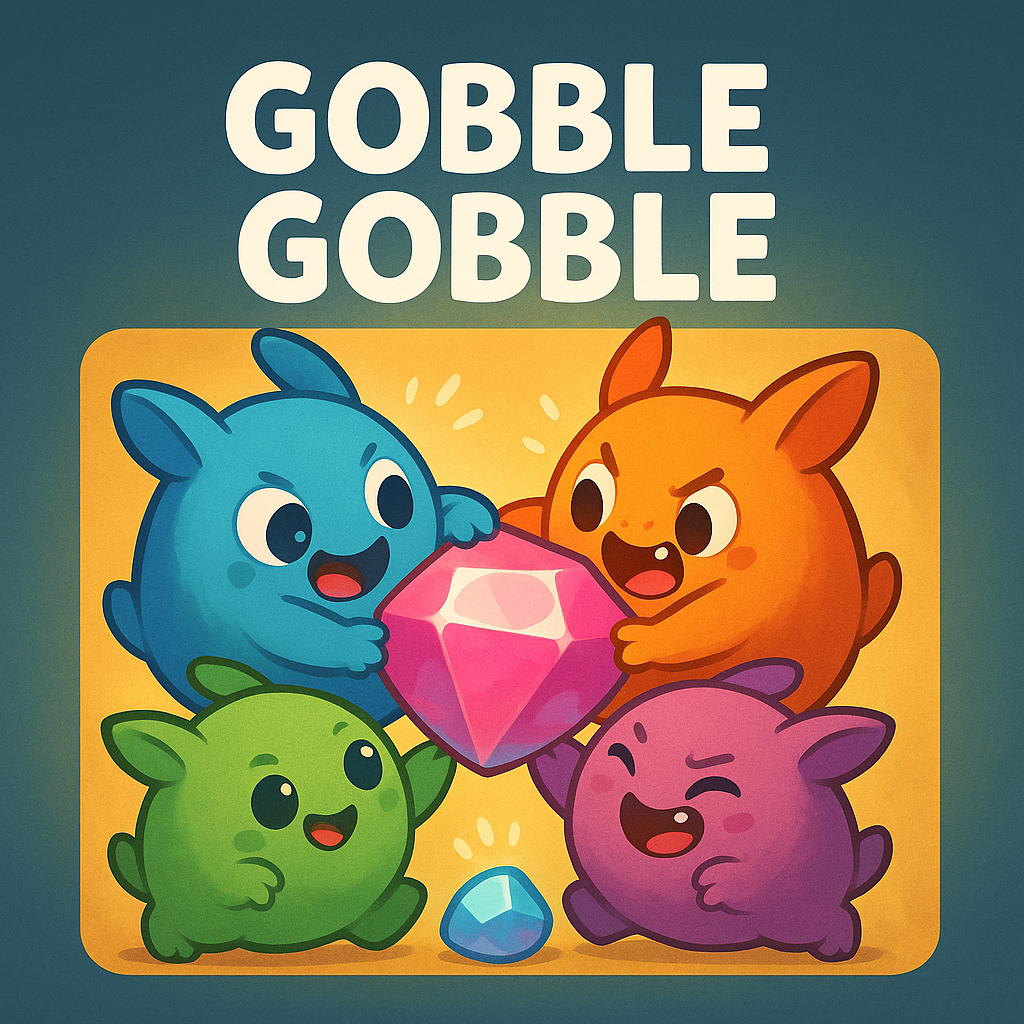
In Gobble Gobble, up to four players control colorful creatures known as Gobbles, racing across the board to gather gems and return them to their personal dens. Players can acquire gems in multiple ways, including reaching the central chest, stealing from other players, or raiding another player’s den. Combat is resolved through dice rolls, allowing players to steal gems or even steal an opponent’s soul, permanently removing them from the game.
The game blends light tactical decision-making, movement strategy, and press-your-luck risk management through its mixture of combat, resource stealing, and revival mechanics. Victory is achieved by collecting 10 gems or being the last Gobble standing.
Project Overview
Gobble Gobble features:
Four-player competitive gameplay with color-coded Gobble characters
Gem acquisition system using dice rolls and the central chest
Stealing & combat mechanics requiring players to land on the same tile to initiate battles
Den-raiding mechanics to slow opponents nearing 10 gems
Soul stealing & revival system introducing elimination, comeback, and escalating stakes
Movement upgrades through purchasable hats at the store
For my first game design document, I approached the system holistically: player setup, board layout, movement rules, resource distribution, win conditions, store economy, and revival limitations. It was my first experience building a game loop from scratch and documenting it clearly for others to execute.
Tools Used
Paper prototyping
Physical board and token design
Writing, puzzle scripting, and diagramming
Manual playtesting with classmates
What I Worked On
Designed the full gameplay systems (combat, movement, stealing, revival, win states)
Created the full rulebook, including setup, turn structure, and examples
Balanced player progression using dice odds, movement ranges, and resource scarcity
Designed the in-game economy, including the store, purchasable hats, and soul usage
Developed the board layout, den structure, and chest interactions
Structured the document using professional GDD formatting for the first time
What I Learned
Designing Gobble Gobble as my very first board game taught me several foundational lessons that shaped the designer I would eventually become:
How to structure a complete game loop from scratch — including setup, turn flow, win conditions, and escalation.
The importance of clarity in rule writing, especially when players must navigate the system without help.
How to run and interpret blind playtests, observing where players get confused and identifying where the design or rules need refinement.
Balancing the game economy and risk–reward loops through dice probabilities, gem distribution, and store purchases.
How player psychology interacts with mechanics — for example, how theft and denial systems heighten tension and create memorable moments.
How to iterate quickly based on real-time player behavior rather than my original intent for the design.
The value of simplicity — learning that a game doesn’t need to be complex to be strategic, fun, or engaging.
Gobble Gobble was my first experience thinking like a game designer instead of just a player. It taught me the fundamentals of communication, systems thinking, and balancing — lessons that carried forward into every game I built afterward.
Personal Reflection
Gobble Gobble holds a special place in my heart as the very first board game I ever designed and my first attempt at writing a formal rulebook. It was also my first real experience with blind playtesting — where my classmates played the game without me explaining anything. Watching them interpret (or misinterpret!) my rules was invaluable.
This early experience taught me:
how critical clarity and conciseness are in rule writing
the importance of teaching players just enough to get them playing quickly
how to avoid overwhelming new players with unnecessary detail
how to identify broken mechanics by watching others play
how to balance game pacing and player escalation
Even though Gobble Gobble is simple by today’s standards, it laid the foundation for everything I would go on to create. It is the earliest example of my design instincts forming — and a reminder of how excited I was to begin my career in games.